Collect supplier evidence, validate land plots, structure shipment-level traceability, and prepare audit-ready records in one workflow — with AI-assisted document review, supplier onboarding, and evidence checks.
Plotwiser is built for organizations managing multi-supplier, multi-origin sourcing under real regulatory pressure — not for simple, single-origin setups.
Managing hundreds of suppliers across multiple origins. Need structured proof that upstream sourcing is deforestation-free.
Placing regulated products on the EU market. Need to file DDS declarations backed by validated geolocation and risk data.
Reviewing evidence, tracking exceptions, and preparing audit-ready records across commodity groups and business units.
Each step maps to a real operational task your team already does — Plotwiser structures and connects them into a defensible due diligence workflow.
Onboard suppliers, products, and purchase orders. Entity resolution via GLEIF. EU sanctions screening. 8-category country risk scoring.
IntakeCollect geolocation files, farm records, and supporting documents from suppliers. GeoJSON, KML, WKT, and GPS coordinate support.
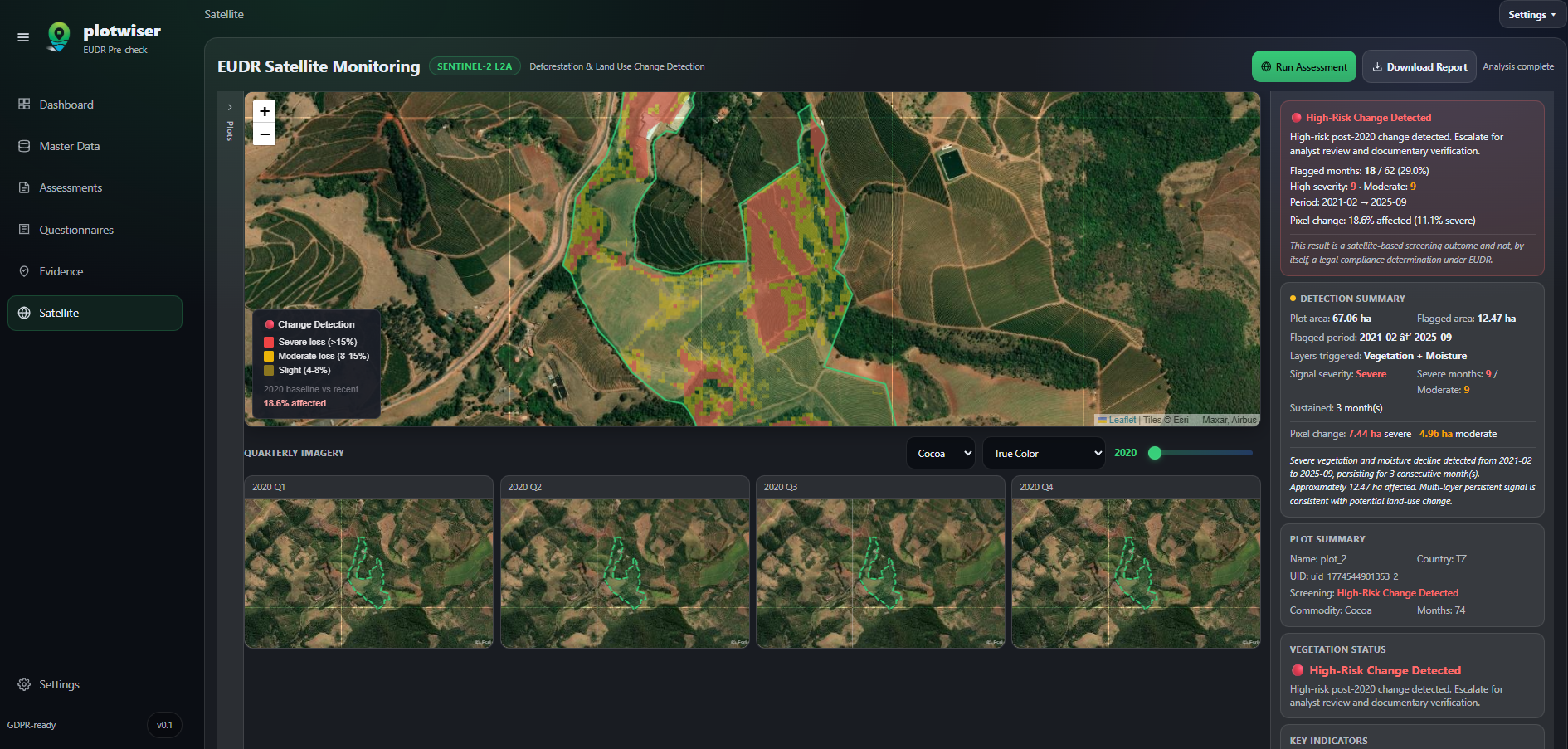
EvidenceEUDR v1.5 geolocation validation. Multi-layer satellite screening with vegetation analysis, disturbance detection, and commodity-specific deforestation thresholds.
VerificationConnect supplier, farm, plot, and shipment records into a traceable structure. Map upstream sourcing to downstream due diligence.
TraceabilityFlag missing evidence, incomplete records, and elevated risk scores. Guided remediation workflows with supplier outreach tracking.
ReviewGenerate PDF reports with satellite evidence and risk verdicts. TRACES NT-compatible DDS export. 5-year record retention per Art. 12.
OutputNot another dashboard on top of your data. Plotwiser is the structured workflow that connects supplier evidence to audit-ready proof.
Collect structured data and documents from suppliers without relying on fragmented emails and spreadsheets.
Validate production locations, land plot files, and supporting evidence in a workflow built for traceable sourcing.
Connect supplier, farm, plot, and shipment records into a due diligence structure teams can review and defend.
Organize evidence, decisions, and risk outputs into a format teams can use for internal review, customer requests, and regulatory submissions.
Every module is built around a real compliance task — structured, connected, and fully automated.
EUDR compliance is not a reporting exercise. It is an operational challenge involving fragmented data, inconsistent supplier records, and complex sourcing structures.
Farm records, geolocation files, and certificates arrive in different formats across email, WhatsApp, and shared drives.
Coordinates in different formats, missing polygons, inconsistent precision. No way to validate at scale.
Certificates, legality documents, and risk assessments scattered across systems with no structured review process.
When regulators or customers ask for proof, teams scramble to reconstruct decisions from emails and spreadsheets.
Configurable forms collect the right data upfront. Automated completeness checks flag gaps before they become problems.
EUDR v1.5 spec validation, coordinate normalization, and satellite-based deforestation screening in one step.
Documents linked to suppliers, plots, and shipments. AI classification, validity checks, and registry cross-referencing.
Every decision, risk assessment, and evidence review is timestamped and traceable. Export-ready for regulators and customers.
Each commodity has different sourcing structures, risk profiles, and evidence requirements. Plotwiser adapts the workflow accordingly.
Plotwiser is designed around the operational requirements of Regulation (EU) 2023/1115, not around generic sustainability reporting.
Every document, certificate, and geolocation file is collected through configurable intake workflows — not ad-hoc email threads.
Risk assessments, exception handling, and compliance decisions are logged with timestamps, user attribution, and full audit trail.
Supplier, plot, shipment, and evidence records are linked in a structured hierarchy that maps to EUDR due diligence requirements.
"Plotwiser turned our EUDR compliance from a six-month project into a two-week setup. The satellite screening alone saved us hundreds of hours of manual plot verification."Head of ComplianceEuropean Coffee Importer · 200+ suppliers
"The PlotPilot AI agent changed how we work with suppliers. It drafts outreach, tracks responses, and keeps remediation on track — we just review and approve."Supply Chain DirectorGlobal Cocoa Trader · 12 origin countries
Regulation (EU) 2023/1115 requires all operators and traders placing coffee, cocoa, palm oil, soya, cattle, wood, rubber, and derived products on the EU market to prove their supply chains are deforestation-free after December 31, 2020. This applies to importers, traders, and any operator in the supply chain.
Plotwiser runs multi-layer satellite analysis on every land plot — including vegetation baselining, disturbance screening, forest degradation assessment, and temporal coverage verification from the EUDR cutoff date to present. This generates risk classifications with commodity-specific thresholds, providing audit-ready evidence for deforestation screening.
A DDS is the formal declaration operators must submit via the EU TRACES NT system before placing regulated products on the market. Plotwiser generates TRACES-compatible DDS documents with linked evidence, risk assessments, and geolocation data.
Fines of up to 4% of annual EU-wide turnover, confiscation of products, exclusion from public procurement, and temporary bans on placing products on the EU market.
Plotwiser supports multi-tier supplier relationships, blended sourcing, and lot-level traceability. Records are structured hierarchically — supplier to farm to plot to shipment — so teams can trace any product back to its origin.
Book a walkthrough to see the workflow — from supplier onboarding to audit-ready compliance records.
Upstream operator obligations, DDS requirements, and key risks to manage.
Scope, timeline, commodities, penalties, and how to comply before December 2026.
Supply chain mapping, geolocation, risk assessment, and DDS submission.